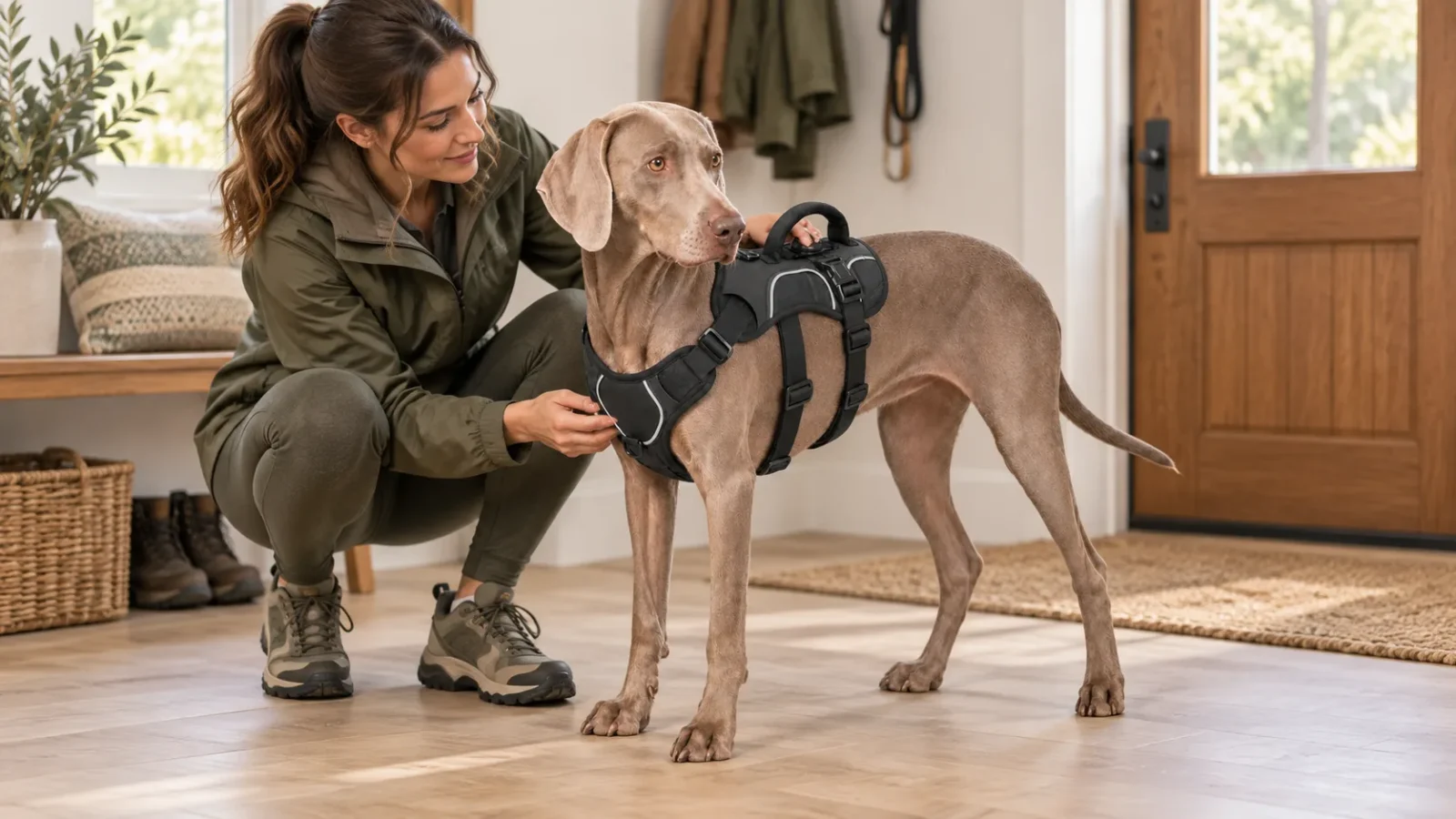
A dog that backs away while the leash pulls forward may slip out of a poorly fitted harness. Before choosing a design with more straps, check how the current harness moves and whether its shape and adjustment range suit your dog.
Dogs that repeatedly back out of walking gear are often called "escape artists" or "Houdini dogs." The label does not explain the cause: both the fit and the situations that trigger the retreat need attention.
Quick answer: A 3-strap dog harness, sometimes described as a 3-point harness, adds a rear body strap to the neck/chest and ribcage sections. Some designs position that strap behind the widest part of the ribcage to make slipping forward more difficult when correctly fitted. Whether a particular harness suits your dog depends on its proportions, adjustment range, and fit during movement. No harness is escape-proof, and a third strap does not replace training, attentive handling, or checking the equipment before a walk.
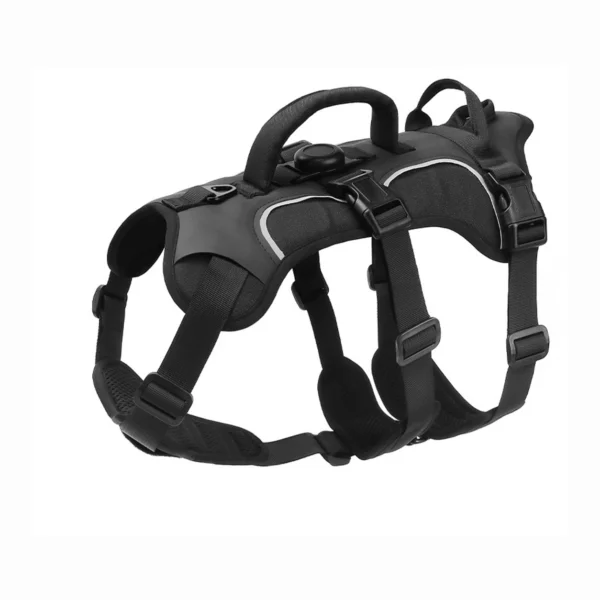
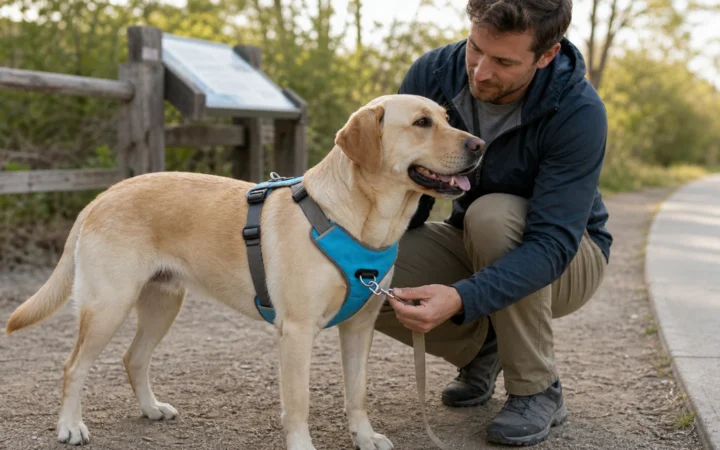
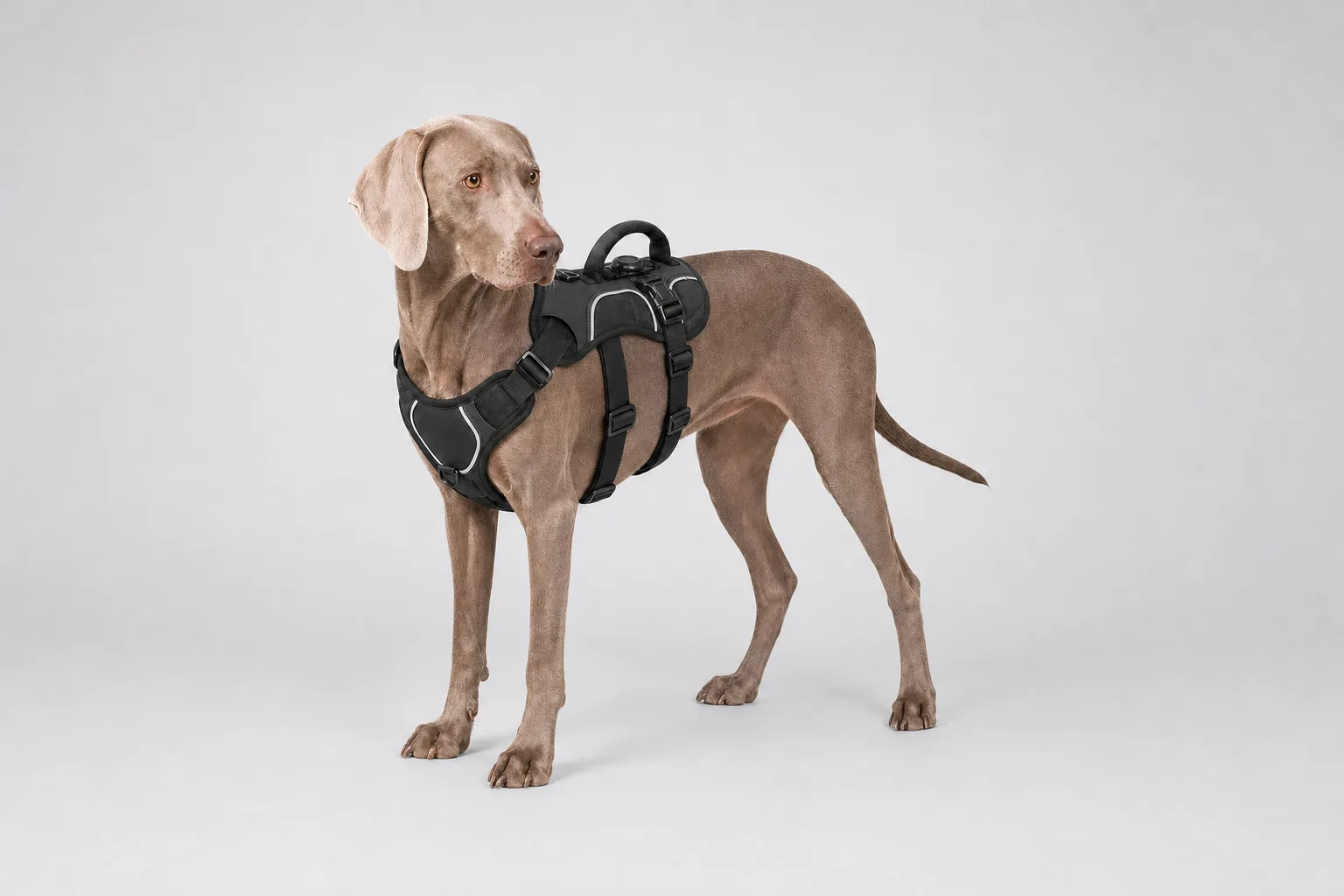
Image note: the header is an illustrative pre-walk scene based on the current Mydoggg harness. It is not a field test or a verified fit result. The product image below is current Mydoggg catalog artwork.
Why Dogs Back Out of Harnesses
Start with how the harness moves on your dog. Loose adjustment, an unsuitable shape or size, and leash tension can all matter; fabric strength alone does not establish a good fit.
Simplified layout: A common walking harness has a front neck/chest section and a ribcage strap. A 3-strap design adds another body strap farther back. This describes the general arrangement, not the correct fitting position for every model or dog.
Many everyday walking harnesses have two main contact sections:
- A neck or shoulder loop resting against the lower neck or chest bone.
- A girth strap circling the ribcage directly behind the front legs.
What to Check When Your Dog Reverses
If your dog lowers its head and backs away, watch for the neck opening moving toward the ears, the body strap sliding toward the front legs, or the back panel rotating. These are reasons to stop and reassess the fit, rather than pull harder to see whether the harness holds.
A dog with a deep chest and a narrower waist may need a different adjustment range from another dog of the same weight. Check the individual dog's measurements and movement instead of assuming that a breed name establishes the right harness shape.
What Is a 3-Strap (3-Point) Dog Harness?
A three-section design extends farther along the torso. The extra coverage is worth considering when your dog's current harness shifts forward, but tightening an unsuitable harness is not a substitute for finding the right shape and size.
The three sections usually include:
- Front Neck / Chest Section: Follow the model's fitting instructions for its position across the front of the body.
- Main Ribcage Strap: Encircles the body behind the front legs, with clearance for movement.
- Rear Body Strap: Adds a separate contact point farther back. Its intended position depends on the design and the dog's body length and proportions.
What the Rear Strap Changes
In a design intended to sit behind the widest part of the ribcage, the rear strap may resist forward movement that a shorter harness allows. This depends on the strap reaching the intended position and remaining comfortably adjusted as the dog moves. It is not a rigid lock or proof that the dog cannot escape.
For example, the Mydoggg 3-Strap Large Dog Harness has a three-section layout with two separately adjustable belly straps. That describes its coverage; it does not establish an escape-prevention rating. Check each strap and the complete fit before relying on it outdoors.
3-Strap Harnesses vs. Popular Alternatives
When searching for an "escape proof dog harness," compare the actual model specifications and fitting instructions. The descriptions below come from the linked product pages; they are not results of a side-by-side escape test.
On a small screen, scroll the table sideways to read every column.
| Model | Published Construction and Adjustment Details | What to Compare for Your Dog |
|---|---|---|
| Mydoggg 3-Strap Large Dog Harness | Two adjustable belly straps, two control handholds, front and rear leash points | All three measurements in its L/XL chart and the position of both belly straps |
| Ruffwear Flagline | Six adjustment points, three leash attachment points, padded handle and chest/belly panel; manufacturer describes lift-and-assist use | Its own size chart and fitting instructions; those lifting features do not establish lifting suitability for other harnesses |
| Indi-Dog Custom Fit Houdini | Custom fit with fleece or softshell padding; chest adjustment, with neck and between-leg dimensions made to measurement | Required custom measurements and which parts remain adjustable |
| Blue-9 Balance | Six adjustment points, front and back leash rings, buckle on the neck loop | Neck opening, body length adjustment, and clearance during movement |
An extra strap, a higher price, or a brand's product name cannot tell you how a harness will fit your individual dog. Keep fit, comfortable movement, and the manufacturer's intended use central to the comparison.
Dog Girth Measurement: Sizing for a 3-Strap Harness
Never buy by weight alone. Compare every measurement required by the specific product's chart, then check the harness on your dog. Different manufacturers use different measurement points, even when their size labels look similar.
For a detailed walkthrough, review our complete guide on how to measure and fit a dog harness.
The Three Measurements for the Mydoggg Model
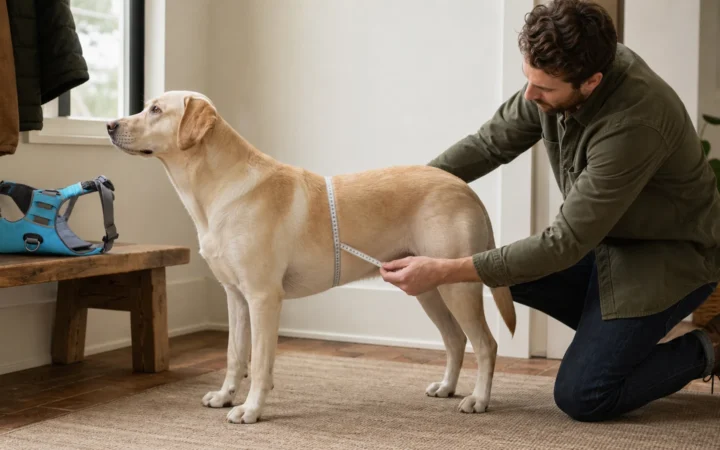
Measure while your dog is standing, following the product's measurement diagram:
- Lower Neck: Around the base of the neck where the neck section sits.
- Front Chest: Across the front chest between the indicated strap points. This is a length, not the circumference of the abdomen.
- Chest Girth: Around the widest part of the ribcage behind the front legs.
The current Mydoggg product chart lists:
On a small screen, scroll the table sideways to read every column.
| Size | Neck | Front Chest | Chest Girth |
|---|---|---|---|
| L | 42–63 cm | 32–42 cm | 66–91 cm |
| XL | 48–74 cm | 35–47 cm | 71–102 cm |
Compare all three measurements within the same size row. If both sizes match, or none does, ask for sizing help rather than choosing from chest girth alone. Do not substitute rear belly circumference for front chest length.
The rear strap still needs a separate hands-on fit check: it should reach the position intended for that model without rubbing, restricting movement, or needing excessive tightening. A matching size chart is only the starting point.
How to Adjust the Harness and Check for a Loose Fit
A harness that shifts can be too loose, but it can also be the wrong shape or size. Follow the model's instructions and make these checks in a quiet, enclosed space before a walk.
Step 1: Put It On Calmly
- Open the buckles specified in the fitting instructions. Some models have a neck buckle; others go over the head.
- Let your dog approach at their own pace, using rewards without forcing the head through the opening.
- Align the back panel along the spine and check that the straps lie flat and are not twisted.
Step 2: Adjust Each Section
- Front Section: Adjust both sides as directed so the front panel stays centered.
- Main Ribcage Strap: Check clearance behind the front legs and confirm that the strap does not rub as your dog walks.
- Rear Body Strap: Adjust it at the position intended by the manufacturer. Do not move it to the narrowest part of the abdomen simply to make it catch, or over-tighten it to compensate for a poor fit.
Step 3: Check Comfort, Movement, and Hardware
- Use the two-finger check as a starting point: Check for snug clearance under each strap according to the fitting instructions, then watch your dog walk, turn, and sit. Finger clearance alone does not confirm the fit.
- Check for shifting with minimal force: In an enclosed space, make a calm, low-force check for forward movement of the harness. Stop if your dog resists or becomes distressed. A harness that stays in place during this check is not guaranteed to hold during a panic response.
- Inspect the equipment: Confirm that buckles are fully engaged and that webbing, stitching, rings, and handholds are undamaged. Stop using the harness if you notice damage, pain, rubbing, coughing, gagging, or restricted movement.
Our Dog Harness Fit Checker combines lower neck, front chest, and chest girth measurements with hands-on checks. A size candidate appears only when all three values fit a verified chart; the tool cannot certify safety or escape prevention.
Control Handles and Leash Connections
These features vary by model. On the Mydoggg 3-Strap harness:
- Padded Top Handle and Secondary Handhold: These provide two positions for closer handling. The product describes them as control points; do not assume they are suitable for suspending a dog's weight.
- Front and Rear Leash Points: Choose the connection suited to your walking setup, and check the ring, buckle, and straps before use. Neither connection trains a dog to stop pulling. For the practical differences, see front-clip vs. back-clip dog harnesses.
Frequently Asked Questions (FAQ)
Can a 3-strap harness guarantee my dog will never escape?
No harness is escape-proof. A dog may slip out because the design or fit is unsuitable, even without a broken buckle. Check fit and equipment before each walk, stay attentive, and address the situations that cause your dog to retreat.
What should I do if my dog is an extreme flight-risk or reactive escape artist?
Ask a qualified trainer or behaviour professional to help assess the triggers, fit, and walking setup. A backup connection may be part of that setup, but it needs appropriate hardware and adjustment. Two connections sharing one clasp are not independent protection against that clasp failing. Do not rely on extra straps or a backup connector as a guarantee.
Is a 3-strap harness suitable for small dogs or young puppies?
Some three-section models come in small sizes: for example, Ruffwear Flagline lists XXS and XS. The Mydoggg model discussed here is offered in L and XL. Those are limits of this product's range, not a rule about the whole category.
For a small dog or growing puppy, compare the exact measurements, body coverage, and fit during movement. Recheck as the puppy grows; age or weight alone does not establish whether a particular model fits.
How do I know if the rear belly strap is too tight?
Check for restricted movement, rubbing, and signs of discomfort rather than relying on a finger count alone. If your dog arches its back, hesitates to move, coughs, or appears uncomfortable, stop using the harness and reassess its fit. For signs of pain or breathing difficulty, seek veterinary help; tightening or loosening a strap does not establish the cause.
Recommended Next Steps
- If your dog has a history of backing out of walking gear, compare the 3-Strap Large Dog Harness with Control Handle with your dog's measurements and fit needs.
- Enter lower neck, front chest, and chest girth measurements in the Dog Harness Fit Checker, then complete the hands-on checks before a walk.
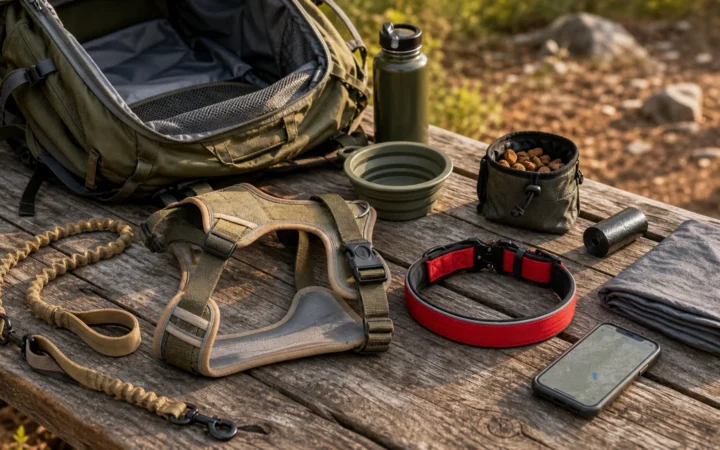
- For technical hiking or long trail excursions, explore our Dog Hiking Gear Checklist for essential hydration, visibility, and safety gear.